
Against the backdrop of industrialised nations (G-8) putting curbs on full nuclear cooperation with countries like India, Prime Minister Manmohan Singh leaves for Paris on Monday hoping that the visit would help India and France "build" its strategic partnership in nuclear energy, defence and other areas.
Such a partnership between the two countries, after the civilian nuclear deal, is essential to jointly meet the challenges of climate change, prime minister's special envoy on climate change Shyam Saran told a meeting of US corporate leaders organised by the US India Business Council. USIBC had played a significant role in the passage of the Indo-US civilian nuclear deal, despite tough hurdles.
India and Sri Lanka on Tuesday signed two separate agreements on combating international terrorism and avoidance of double taxation, eyeing elevation of "robust" bilateral ties to building of a special economic partnership.
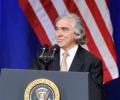
Moniz, who is expected to meet Indian officials on March 10 and 11, had put off the trip last month in view of the strained relations between the two countries over the arrest of senior Indian diplomat Devyani Khobragade in New York.

For existing technologies, unless appropriate financing is available, deployment at scale is difficult.
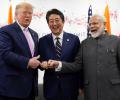
Prime Ministers Modi and Abe enjoyed a close and empathetic relationship and this certainly gave a sustained momentum to the India-Japan strategic partnership. It is necessary for India to reach out and engage with his successor as early as possible, advises former foreign secretary Shyam Saran.
'Romania fully understands and supports India's intention to expand its possibilities to generate civil nuclear power.'

Prime Minister Narendra Modi urged CEOs of US majors to take advantage of India's growth story as the country is making all efforts to become the third largest economy of the world in his third term. India is currently the fifth largest economy of the world after the US, China, Germany and Japan with a GDP of around $3.9 trillion. India has been the fastest growing large economies of the world with GDP growth rate of over 7 per cent for the last three consecutive years.

Ahead of his much-anticipated visit to conflict-torn Ukraine, Prime Minister Narendra Modi on Thursday said India firmly believes that no problem can be solved on the battlefield and it is ready to extend all possible cooperation for the restoration of peace and stability in the region.

The two PMs may also explore ways to further deepen ties between the navies of the two countries to check China's heightened activities in the Indian Ocean.
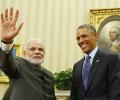
With their landmark 2005 civil nuclear deal still in limbo, India and the United States have established an inter-agency contact group to sort out outstanding liability and technical issues to fast-track its full implementation.

Ron Somers, founder and CEO of India First Group and the former President of leading business advocacy group US-India Business Council said that when Lok Sabha election results are declared on June 4, "I believe that Narendra Modi will win Parliament by the largest majority ever recorded in the country's history.
China was forthcoming and supportive of international civil nuclear energy cooperation with India as the two countries affirmed their readiness to take their strategic and cooperative partnership to a new level at the ASEAN summit in Singapore on Wednesday.
.jpg)
Climate change and US-India collaborations in renewable energy resources will be up for discussion at the US-India energy summit coinciding with Prime Minister Narendra Modi's visit to Washington, DC, later this month, reports Aziz Haniffa.

The 2 countries signed 15 agreements including one on defence cooperation after Prime Minister Narendra Modi held 'productive discussions' with President Joko Widodo.

We have the workforce, now we need to ensure that we take full advantage of game-changing technologies and geopolitical openings, suggests Jayant Sinha, chairman, Parliament's Standing Committee on Finance.

Kerry said Obama has called the relationship with India 'a defining relationship of this century'.
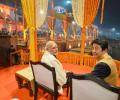
'Modi and Abe are working seriously for India-Japan bonhomie to grow stronger.' 'It is a win-win situation for both countries and the future look promising,' says Rajaram Panda, the Indian Council for Cultural Relations India Chair Visiting Professor at Reitaku University, Japan.
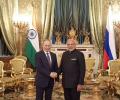
Modi, who arrived in Moscow on Wednesday on a two-day visit, held talks with Putin during a restricted meeting in Kremlin to begin the 16th India-Russia Summit.

Prime Minister Narendra Modi and Sri Lankan President Maithripala Sirisena on Monday held talks at Hyderabad House
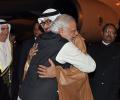
During Al Nahyan's three-day visit, his first to India, the two countries will discuss ways to enhance ties in a range of areas including energy, economy and security and are expected to sign a number of agreements in sectors like oil nuclear energy, IT, aerospace, railways and electronics.

Prime Minister Narendra Modi on Thursday said even though India's options have increased, Russia will remain the country's "most important" defence partner as Moscow offered to fully manufacture in this country one of its most advanced helicopters.

The Indian position on the Russia-Ukraine war and the unconditional treaty between China and Russia appear to have caused some ripples in India-US relations and led to a reappraisal of India's usefulness to the US in the eventuality of a conflict with China, notes Ambassador T P Sreenivasan.

The strategic pacts were inked after the summit between Prime Minister Narendra Modi and his Japanese counterpart Shinzo Abe during which they also discussed international and regional issues of mutual importance including UN security reforms.

Russian President Vladimir Putin arrived in New Delhi late on Friday night for annual summit talks with Prime Minister Narendra Modi on Thursday that is aimed at building on the already close strategic ties, particularly in the fields of nuclear energy, hydrocarbons and defence.
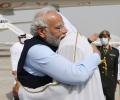
Prime Minister Narendra Modi will visit Abu Dhabi on July 15.
The group has lined up close to a dozen projects, which will take the company's installed capacity to around 18,000 mw.

Modi said both sides expressed commitment for an open, efficient and rules-based regional architecture and to expand bilateral maritime cooperation further.

An agreement to expedite the Jaitapur nuclear plant was expected to be signed.
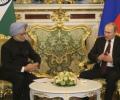
In a clear attempt to allay Russia's apprehensions, Prime Minister Manmohan Singh on Monday said it will remain an "indispensable" partner for India's defence needs even as he underlined that the bilateral ties should adapt to changing times to address challenges.

The two PMs called upon all countries to work towards rooting out terrorist safe havens and infrastructure.

India has a 'natural global partnership' with US, says PM.

New Delhi has reached out to Moscow while waiting for a new president in Washington. New Delhi knows well that in international relations, there are no permanent friends or foes, only permanent national interests, points out Dr Rup Narayan Das.

India and Russia on Thursday decided to expand cooperation in various sectors as they signed 16 pacts, including on joint manufacture of 226 military helicopters.
'When George Bush Senior decided in 1992 that India and the United States must start talking in this-now-changed world, who would have thought that 10, 15 years down the road, we will start looking at each other as strategic partners?'

This could be their last meeting as leaders of the two countries with Obama's second term as US President coming to an end in November.

The reimposition of sanctions on Iran will have major impact on countries like India, with which it has traditional and historic trade relationship.
